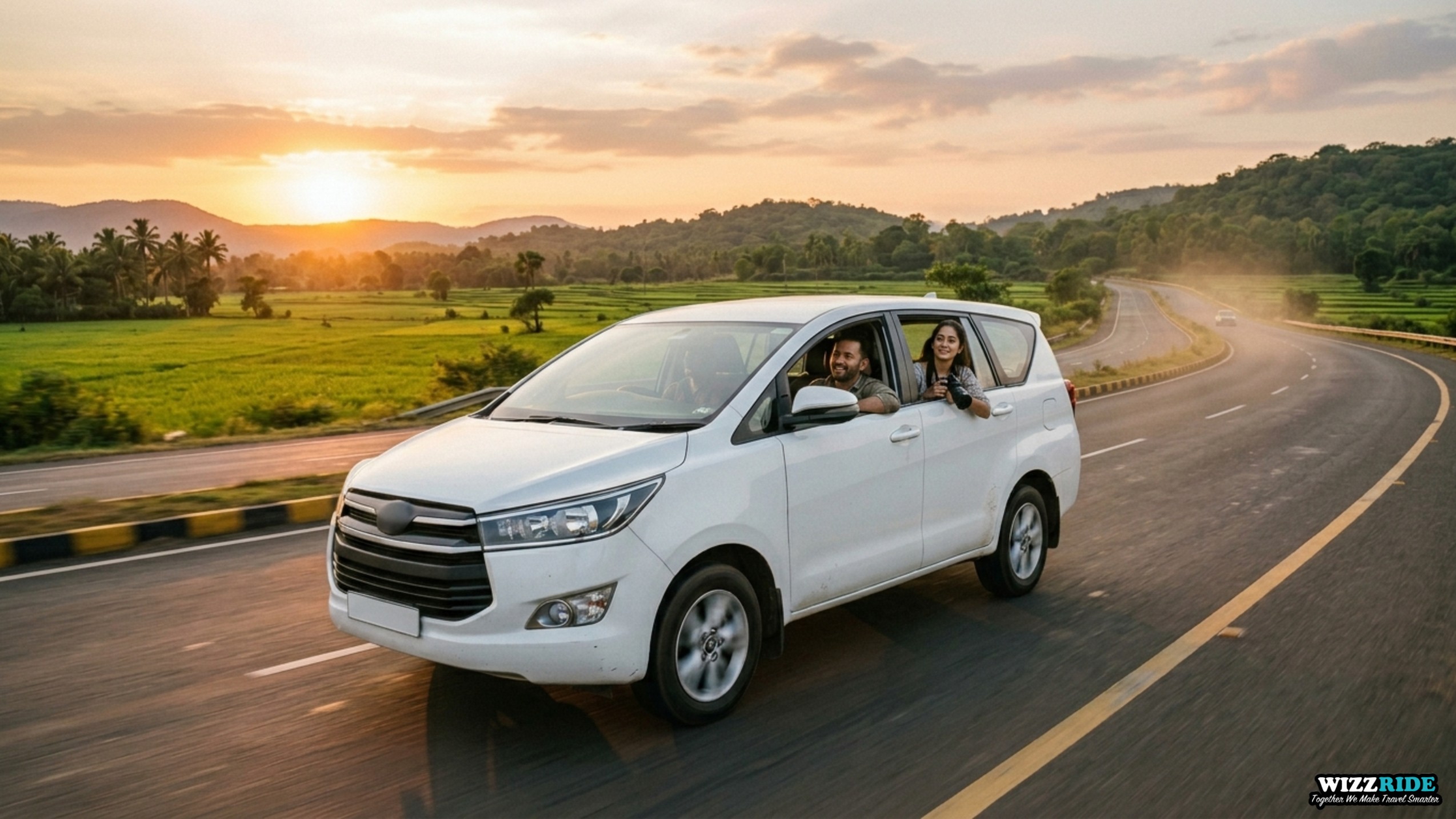
Shared mobility in India is transforming how people travel between cities, airports, and tourist destinations. From shared cab booking and carpooling to ride sharing and airport shared taxis, travellers are increasingly choosing affordable, fuel-efficient, and environmentally responsible transport solutions.
Across Northeast India, routes such as Guwahati to Shillong, Bagdogra to Gangtok, and Siliguri to Darjeeling are witnessing strong demand for professionally managed shared cab services — and the numbers explain exactly why.
India currently has over 354 million registered vehicles on its roads. The average car carries just 1.5 people. In Delhi, that figure drops to 1.15 persons per vehicle. Bengaluru commuters lose 117 hours every year to traffic. Petrol now costs between ₹94 and ₹111 per litre across Indian metros. The financial, environmental, and logistical case for shared mobility has never been stronger.
🚖 Wizzride Shared Mobility Pre-booked shared cabs and airport transfers across Guwahati, Shillong, Gangtok, Darjeeling, Bagdogra and Siliguri. Verified drivers, fixed schedules, affordable per-seat pricing. Visit wizzride.com
What Is Shared Mobility?
Shared mobility refers to transportation systems where multiple passengers share the same vehicle while travelling in the same or similar direction. Instead of each person hiring a full vehicle, travellers share the cost, the space, and the environmental impact of a single journey.
Shared mobility covers a wide range of transport types:
- Shared cab booking — pre-booked per-seat intercity cab travel
- Carpooling — co-travellers sharing a vehicle on a regular commute
- Ride sharing — app-based or pre-arranged shared trips
- Airport shared taxis — fixed-route shared transfers from airport to city
- Intercity shared cabs — shared Innova Crysta or similar vehicles on fixed corridors
- Seat-based taxi booking — booking and paying for one seat, not the whole vehicle
The concept is not new in Northeast India — shared Sumos and shared cabs have operated the Guwahati–Shillong and Bagdogra–Gangtok corridors for decades. What is new is the formalisation, pre-booking technology, and government policy support now backing it.
Why India Is Moving Towards Shared Mobility
Three converging forces are driving India’s shift toward shared mobility in 2026:
1. A Traffic Crisis That Cannot Be Solved by More Roads
- Bengaluru commuters lose 117 hours per year to traffic — ranked 3rd worst globally (TomTom Traffic Index 2024)
- Mumbai commuters lose 103 hours per year
- Kolkata averages 34 minutes 33 seconds per 10 km — India’s slowest city
- Guwahati registered 113,293 new vehicles in FY 2023-24 alone — ~9,441 new vehicles every month — while public transport covers just 8% of trips
- Delhi’s average car occupancy is just 1.15 persons per vehicle
2. Rising Fuel Costs Hitting Every Traveller
- Petrol now costs ₹94–111 per litre across Indian metros as of May 2026
- India imports over 85% of its crude oil — every solo commuter adds to the import burden
- The Economic Survey 2024-25 found that widespread carpooling could save 380 million litres of fuel annually across India
3. A Carbon Emission Crisis Demanding Action
- Transport accounts for approximately 14% of India’s direct CO2 emissions (Economic Survey 2025-26)
- A 4-person carpool can avoid approximately 1,000 kg of CO2 per person per year on a standard daily commute
- BlaBlaCar’s 2024 Sustainability Report (audited by Deloitte) found that carpooling globally avoided 2.5 million tonnes of CO2 in 2024 — a 25% increase over 2023
📈 By the numbers The Economic Survey 2024-25 estimates that widespread carpooling in India could eliminate 780,000 daily vehicle trips from Indian roads — without building a single new road or metro line.
Shared Cab vs Reserved Cab — Which Is Right for You?
| Feature | Shared Cab | Reserved Cab |
|---|---|---|
| Cost | Per seat — significantly lower | Full vehicle cost |
| Best for | Solo travellers, couples, budget travel | Families, groups of 4+, corporate travel |
| Departure | Fixed scheduled slots | Flexible — departs on your schedule |
| Fuel usage | Shared across passengers — lower per person | Full fuel cost to one traveller |
| CO2 emissions | Significantly lower per person | Higher per person |
| Privacy | Shared with co-passengers | Entire vehicle for your group |
| Booking | Pre-book one seat online | Pre-book full vehicle online |
How Much Does Shared Cab Booking Save? Real Route Comparisons
The savings from choosing a shared cab over a reserved taxi are substantial — especially on Northeast India’s most popular intercity routes:
| Route | Reserved Taxi Cost | Shared Cab Cost (per seat) | Saving per Trip |
|---|---|---|---|
| Guwahati → Shillong (99 km) | ₹2,500–₹3,500 | ₹300–₹500 | Up to ₹3,200 |
| Bagdogra → Gangtok (124 km) | ₹3,500–₹5,000 | ₹400–₹700 | Up to ₹4,600 |
| Siliguri → Darjeeling (75 km) | ₹3,000–₹4,000 | ₹350–₹600 | Up to ₹3,650 |
| Guwahati Airport → City (20 km) | ₹800–₹1,200 | ₹200–₹350 | Up to ₹1,000 |
For a frequent intercity traveller making the Guwahati–Shillong journey twice a month, switching to a shared cab saves over ₹48,000 per year.
How Shared Mobility Reduces Traffic, Fuel Consumption & CO2 Emissions
The environmental and fuel benefits of shared mobility are direct and measurable:
| Metric | Solo Driver | 4-Rider Shared Cab |
|---|---|---|
| Vehicles on road (per 4 commuters) | 4 vehicles | 1 vehicle |
| Daily fuel cost per person (20 km, ₹100/L) | ₹267/day | ₹67/day |
| Annual CO2 per person | ~1,340 kg | ~335 kg |
| Annual CO2 saving per carpooler | — | ~1,000 kg (1 tonne) |
| Annual fuel saving per person | — | ~435 litres (₹43,500/year) |
When four travellers share one cab instead of travelling in four separate vehicles:
- Three vehicles are removed from the road for that journey
- Traffic congestion reduces measurably — a small reduction in vehicles produces a disproportionately large drop in congestion
- Fuel consumption drops by up to 75% per person
- Carbon emissions per traveller reduce by approximately 75%
- Road infrastructure wears at a fraction of the rate
Is Shared Mobility Legal in India? Government Policy & Support
Yes. Shared mobility and pooling are now formally recognised and actively promoted by the Indian government through multiple policy initiatives:
| Year | Initiative | What It Does for Shared Mobility |
|---|---|---|
| 2022 | Mission LiFE (MoEFCC) | Lists carpooling as one of 75 official climate actions for Indian citizens |
| 2022–23 | Assam Motor Vehicle Aggregator Rules 2022 | One of India’s first state-level frameworks formally defining and regulating pooling, women-only pool options, and inter-city shared cabs |
| 2024–25 | Economic Survey 2024-25 | Recommends widespread carpooling to eliminate 780,000 daily trips and save 380 million litres of fuel annually |
| 2025 | Motor Vehicle Aggregator Guidelines 2025 (MoRTH) | Formally recognises “Pooling Facility” in national transport regulation for the first time |
| Apr 2025 | Maharashtra Cabinet approval | First state to fully legalise app-based private carpooling with mandatory insurance and women-only pool option |
✓ Assam was a pooling pioneer The Assam Motor Vehicle Aggregator Rules 2022 formalised and regulated shared cab pooling in February 2023 — over two years before Maharashtra’s widely covered 2025 legalisation. Northeast India led India on this.
Shared Cab Routes Across Northeast India
Northeast India has one of India’s most naturally evolved shared-cab cultures. Long before app-based pooling became a policy conversation, travellers on these routes were already sharing Sumos and Innova Crystas — paying per seat, travelling on fixed schedules, and making journeys more affordable for everyone.
| Route | Distance | Travel Time | Shared Cab Fare |
|---|---|---|---|
| Guwahati → Shillong | 99 km | ~2.5–3 hrs | ₹300–₹500 per seat |
| Shillong → Guwahati Airport | 99 km | ~3 hrs | ₹300–₹500 per seat |
| Bagdogra Airport → Gangtok | 124 km | ~3.5–4 hrs | ₹400–₹700 per seat |
| Bagdogra Airport → Darjeeling | 75 km | ~2.5–3 hrs | ₹350–₹600 per seat |
| Siliguri → Darjeeling | 75 km | ~2.5–3 hrs | ₹350–₹600 per seat |
🚖 Travelling from Guwahati Airport to Shillong? Wizzride offers direct shared cab pickup from the airport arrivals gate — 118 km, 3 to 4 hours via NH6. Read the complete Guwahati Airport to Shillong travel guide.
🚖 Travelling to Gangtok from Bagdogra Airport? Wizzride’s shared cab service covers the 124 km Teesta Valley route from Bagdogra to Gangtok. Read the complete Bagdogra to Gangtok shared cab guide.
Why Travellers Choose Wizzride for Shared Mobility
Wizzride brings professional infrastructure to Northeast India’s existing shared-cab culture — adding pre-booking, verified drivers, fixed schedules, and transparent pricing to corridors that have run on shared travel for decades.
- Pre-booked shared seats — book your seat in advance, not at the stand on the day
- Premium Innova Crysta — comfortable on mountain and hill roads throughout the Northeast
- Verified professional drivers — experienced on Northeast India’s specific road conditions
- Affordable per-seat pricing — you pay for your seat only, not the whole vehicle
- Direct airport pickup — aligned with flight arrivals at Guwahati and Bagdogra airports
- Fixed schedules — no waiting indefinitely for a vehicle to fill up at the stand
- Flight + cab in one booking — book your flight to Guwahati or Bagdogra and your shared cab transfer together
🚖 Book Shared Cabs with Wizzride Affordable airport transfers and intercity shared taxis across Northeast India. Transparent pricing, professional drivers, pre-booking available. Visit wizzride.com or book via the Wizzride app (Android / iOS).
Conclusion
Shared mobility is not a trend — it is the direction of travel for India’s transport future. With government policy now firmly behind it, fuel costs making solo travel increasingly expensive, and traffic congestion making individual vehicles increasingly inefficient, the case for shared cab booking, carpooling, and airport shared taxis is overwhelming.
In Northeast India, this shift is already well underway. The Guwahati–Shillong, Bagdogra–Gangtok, and Siliguri–Darjeeling corridors have run on shared travel for decades. Wizzride brings the professional infrastructure — pre-booking, verified drivers, fixed pricing, airport coordination — that makes this shared-cab culture accessible, reliable, and scalable for every traveller.
Useful References
Frequently Asked Questions
What is shared mobility?
Shared mobility refers to transportation systems where multiple passengers share the same vehicle while travelling in the same or similar direction. It includes shared cabs, carpooling, ride sharing, and airport shared taxis. Passengers pay only for their seat, not the entire vehicle, making it significantly more affordable than solo travel.
Is shared cab booking cheaper than a reserved taxi?
Yes, significantly. A shared cab seat from Guwahati to Shillong costs ₹300–500, compared to ₹2,500–3,500 for a full reserved cab. On the Bagdogra to Gangtok route, a shared seat costs ₹400–700 versus ₹3,500–5,000 for a reserved vehicle. For a frequent traveller, this can mean savings of ₹48,000 or more per year.
Is shared mobility and carpooling legal in India?
Yes. Shared mobility and pooling are formally recognised under the Motor Vehicle Aggregator Guidelines 2025 (MoRTH). Maharashtra became the first state to fully legalise app-based carpooling in April 2025. Assam’s Motor Vehicle Aggregator Rules 2022 have regulated shared cabs and pooling since February 2023 — making it one of India’s earliest state-level pooling frameworks.
Which is the best shared cab service in Northeast India?
Wizzride provides professionally managed shared cab booking across all major Northeast India corridors — including Guwahati to Shillong, Bagdogra to Gangtok, Bagdogra to Darjeeling, and Siliguri to Darjeeling. Wizzride offers pre-booking, verified professional drivers, premium Innova Crysta vehicles, fixed schedules, direct airport pickup, and transparent per-seat pricing.
How does shared cab booking reduce CO2 emissions?
When 4 passengers share one cab instead of travelling in 4 separate vehicles, 3 vehicles are removed from the road for that journey. This reduces CO2 emissions per person by approximately 75%. On a standard 20 km daily commute, each carpooler avoids approximately 1,000 kg of CO2 per year — equivalent to planting over 40 trees annually.
How do I book a shared cab from Guwahati Airport or Bagdogra Airport?
Visit wizzride.com or download the Wizzride app (Android / iOS). Select your route, choose the shared cab option, enter your flight arrival details, and book your seat. Wizzride aligns your cab pickup with your flight arrival time at Guwahati (GHY) or Bagdogra (IXB) airports.